Risk-Based Engineering and Robust Design
Developing safe and effective medical devices requires early identification of design weaknesses, potential failure mechanisms, and safety-related risks.
Integrating Hazard Analysis, Design FMEA (DFMEA), and quantitative engineering methods supports systematic risk assessment, robust design decisions, and effective risk control throughout product development.
Mechanical Stress Analysis
Mechanical calculations and Finite Element Analysis (FEA) identify critical stresses, deformations, and potential structural failures, supporting mechanical integrity and design robustness.
Statistical Tolerance Analysis
Worst-case, RSS, and Monte Carlo analyses evaluate dimensional variations and their impact on critical product functions, supporting tolerance optimization and manufacturing consistency.
Sensitivity Analysis
Sensitivity analysis identifies design parameters that significantly influence product performance, enabling targeted optimization and reduced sensitivity to manufacturing variability.
Reliability Engineering
Reliability analysis evaluates potential failure mechanisms and lifetime performance under defined operating conditions, supporting product reliability and risk-based verification testing.
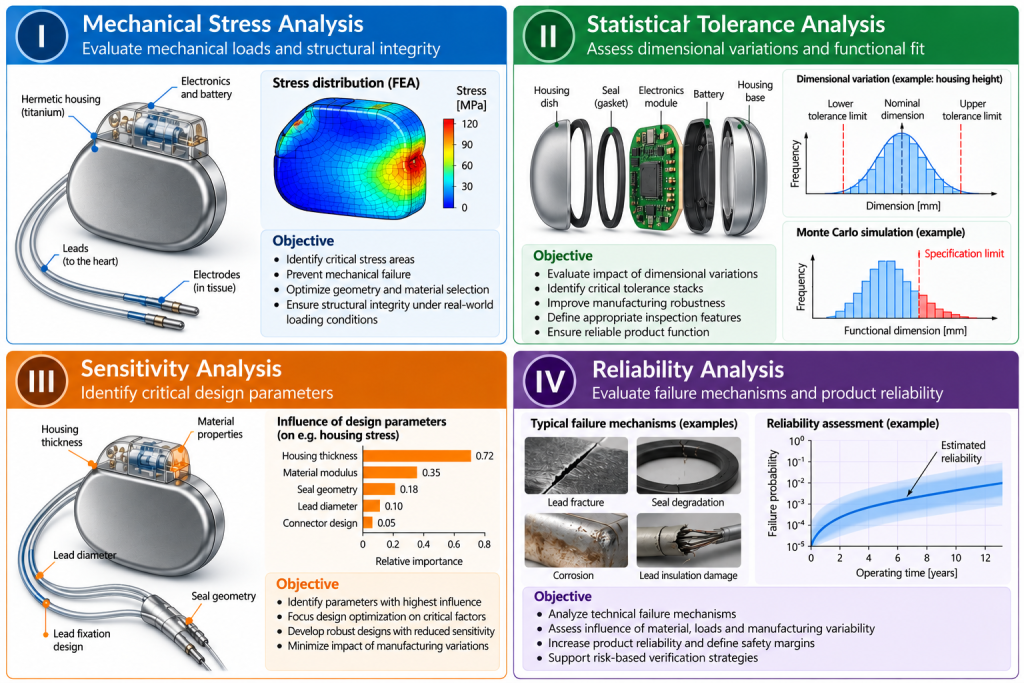
Figure: Quantitative engineering methods supporting early risk identification and robust medical device design.
Risk Management and Design Controls
Engineering analyses are integrated with Hazard Analysis and DFMEA to identify technical failure causes, evaluate design-related risks, and establish appropriate risk control measures.
Risk-based design verification and validation provide objective evidence that design requirements are met, risk controls are effective, and the device fulfills its intended use.
This approach supports a structured development process aligned with ISO 14971 and ISO 13485, emphasizing risk-based decision-making, traceability, and documented verification.
From Risk Identification to Verified Risk Control
Early Risk Identification. Robust Design. Risk-Based Verification. Effective Risk Control.
Integrating quantitative engineering, DFMEA, and systematic risk management supports the development of safe, effective, reliable, and manufacturable medical devices.